 Tableau | Data visualisation | Industry trends | Tool strategy
 New features coming in Tableau 2022.2 - All products
22.2 is nearly out, so let's run through the coming soon page and find out what's actually worth your attention.
- The in-product Exchange brings templates, accelerators and connectors directly into Tableau so you no longer need to download files from a webpage
- An 'add filters' dashboard object lets consumers add their own filters, reducing the endless author requests for slightly different filter sets
- Wildcard union enhancements let you look inside folders and filter by name, creation time, last modified time, last access time and size
- The Metrics REST API endpoint lets you fetch metric data into your own applications and visualise it with tools like D3 or Angular
- 2022.2 is light on desktop-only features; most additions are quality-of-life changes and a large batch of REST API endpoints aimed at managing the platform at scale
- Walking through the coming soon page0:08
- Data stories, autosave and in-product exchange0:27
- Metrics, search and wildcard union enhancements0:57
- Prep column ordering and embedded web authoring2:15
- New connectors, languages and add filters object3:49
- Ask data, lenses and web formatting5:17
- Workbook optimizer, mobile and security7:03
- View acceleration and printing improvements11:04
- REST API additions and the 70+ APIs claim14:17
- Verdict on the desktop features21:02
0:00Hey, it's Tim here and today's video 22.2
0:02is nearly out.
0:03So we're going to go through the coming
0:04soon page
0:05to find out what's new in Tableau.
0:06Let's get stuck in.
0:07Here we are, we're in the coming soon page.
0:09This is what I'm going to go through.
0:10We're just going to do a very quick run
0:12through
0:12of what's new in 22.2.
0:15I'm assuming it's 22.2.
0:16There's no sort of official tag here
0:19saying they will come out in this release.
0:20And sometimes things do fall out of this
0:22release,
0:23but right from the top, let's have a quick
0:26run through here.
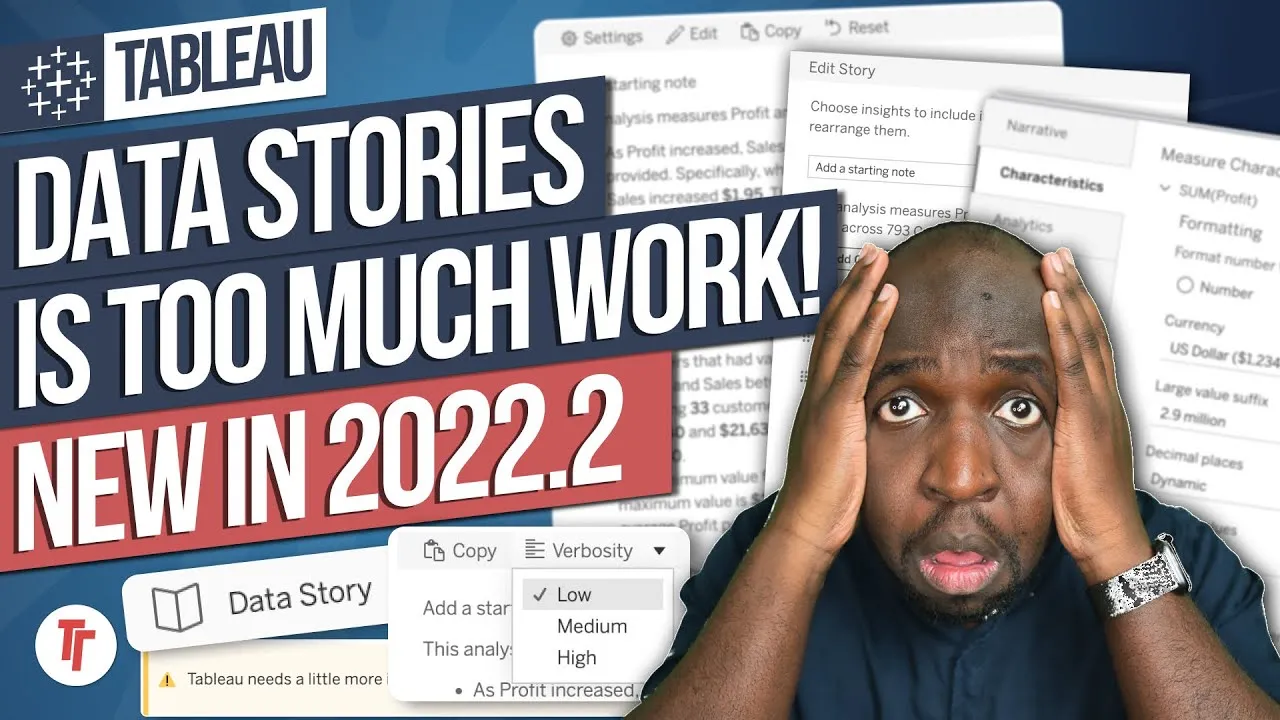
0:26So we've got the data stories feature.
0:28This was demo.conference.
0:30Autosave for Workbooks.
0:31I assume this is Workbooks built in WebEdit
0:35.
0:35I don't think this is in desktop,
0:37but maybe we'll find out soon.
0:38The in product exchange.
0:39This is essentially an extension of the
0:42extension gallery,
0:42which was already in product.
0:44Now this is bringing the whole exchange,
0:46including templates, the accelerators,
0:49and a bunch of connectors all into the
0:51exchange.
0:51So you don't have to head to a webpage
0:53to download a file to work with them.
0:55So that should be sort of cool.
0:57Metrics continues to get enhancements.
0:59This is actually one of my favorite parts
1:00of Tableau
1:01because it's quite focused.
1:02It's really refined.
1:03And what I like is the limitations.
1:05You have to sort of work within a set of
1:06parameters.
1:07I don't like that you have to have a Work
1:09book
1:09that they're connected to.
1:10I would love this just to be attached to a
1:12data source,
1:13but nonetheless, the best experience of
1:15this
1:15actually comes from mobile.
1:17And so what these improvements do,
1:19bring the desktop experience closer
1:21to what we're used to on mobile,
1:22and in some places go even further.
1:24So I think that's going to be a really nice
1:25thing to see.
1:26And we'll obviously have a play with that
1:28when it comes out very soon.
1:30Improved quick search.
1:32Search functionalities were enhanced in the
1:34last release.
1:35In this release, they just keep on getting
1:37better.
1:37So that's to be expected.
1:39It's actually a common theme with lots of
1:40Tableau releases.
1:41They sort of do incremental releases to
1:44sort of feature sets
1:45so that they come across multiple versions
1:48rather than just one.
1:49Wildcard union enhancements.
1:51The specific change here is you can now
1:53look inside
1:53of a folder and filter based on certain
1:56attributes
1:56of the name, creation time, last modified
1:58time,
1:59last access time and size.
2:01These are going to be really nice
2:02enhancements.
2:03In a way, this makes this work
2:04the way it should have worked all along.
2:06So this has probably come through lots of
2:08feedback
2:09from the community asking for things that
2:10they've seen
2:11in other tools like Autrix as well.
2:13So that's a really nice to see.
2:15The next one is an enhancement to prep
2:17again.
2:18This one is column ordering.
2:19So you can change the order in which
2:21columns
2:21leave the data source, not leave the data
2:23source,
2:23the order in which columns are ordered
2:26when you export the files as CSV, databases
2:29, all of that.
2:30You can change the order.
2:31That wasn't the case before.
2:33You had to sort of work with the order you
2:35had.
2:35So this is nice.
2:36You can reorder things and kind of get this
2:39just looking the way you want, which is
2:40kind of good.
2:41So the next thing is embed web authoring.
2:43So you can already embed dashboards
2:47into web pages and portals.
2:49Now you can embed the authoring experience.
2:51So you can give people the ability to edit
2:53from data sources in an embedded setup.
2:56So that's actually quite nice
2:57'cause you're building people the ability
2:58to,
2:59you're giving people the ability to build,
3:01not just consume.
3:02The embedding API has been enhanced,
3:04I think to match this as well.
3:05So the embedding API has sort of been
3:08improved
3:09to meet some of the functionalities that we
3:11're seeing
3:11in this whole new sort of embed slash web
3:14first mentality
3:15that Tableau had been pushing over the last
3:17few years.
3:17I think this is also to enhance technology
3:19such as Tableau Cloud as well.
3:21Tableau Cloud being the new Tableau,
3:23the new name for Tableau Online.
3:26But nonetheless, you've got a bunch of new
3:27things in the API,
3:28the ability to create custom menus and menu
3:30items,
3:31embed web authoring, additional support for
3:33Tableau events
3:34and filtering, support for Tableau
3:36parameters
3:37and view export and much more.
3:39There'll be lots of small things that
3:40really,
3:40unless you're a developer,
3:42you're not gonna notice these things.
3:43As a user, they should just be, you know,
3:45part of the Tableau experience that you're
3:47already used to.
3:49New product language in Canada,
3:51French Canada to be specific.
3:52So that's always nice when Tableau adds a
3:54new language.
3:55It's quite a lot of work to sort of local
3:56ize
3:56a piece of technology.
3:57It's actually a lot sort of more difficult
4:00than you think
4:00because some of the translations have to be
4:03done
4:03in such a way that makes the product menus
4:06and descriptions make sense in those
4:09languages.
4:09A new connector for OneDrive and SharePoint
4:12.
4:12And this is gonna support specific files
4:15that are shared with you as well.
4:16So previously, I don't think you could
4:18access OneDrive files
4:20that were shared with you
4:22and SharePoint document libraries as well.
4:24I think that's an enhancement.
4:25You could have done that before,
4:27but this I think is enhancement.
4:28So we'll see that.
4:30I like this feature.
4:31Give users, authors, the ability to enable
4:35consumers
4:36to add filters of their own.
4:38So this allows the author to put a
4:39dashboard object,
4:40which is called add filters.
4:42Then when the consumer looks at the
4:43dashboard,
4:44they can add their own filters that suit
4:46them.
4:46This is great because so often authors add
4:49100 filters
4:50to a dashboard and then people will ask,
4:52oh, but can I have this one?
4:53And then someone else will ask, can they
4:55have another two?
4:55And before you know it, you've got 10
4:57filters
4:57because everyone asks for a slightly
4:59different set
5:00'cause they like to cut the data up in
5:01different ways.
5:02This will hopefully reduce that request
5:04and just allow people to save their own
5:06custom sets.
5:07Hopefully this integrates with custom views
5:09in the way that I think it should.
5:10So the ability to remember which filters
5:12you've used
5:13and then save those in your custom view
5:15of that particular thing.
5:16Improvements to ask data.
5:19This is actually not something I was
5:20expecting.
5:21So we continue to extend the availability
5:23of ask data.
5:23Adding our state to dashboard is now
5:25smoother than ever,
5:26supported end to end in Tableau desktop.
5:29Okay, great.
5:29So this is essentially the support for ask
5:33data in desktop.
5:34I think previously it had to be done
5:36through web edit.
5:37This actually allows you to fully do
5:38everything in desktop.
5:40So that's a nice thing.
5:41I think previously I thought this was a bug
5:43that you couldn't do it in desktop,
5:44but actually it turns out it's a feature
5:46and now it is a feature.
5:48So that's good to know.
5:50I just been reporting it as a bug, which is
5:52kind of funny.
5:53Lenses meet the catalog.
5:54So lenses will now I think surface in the
5:57catalog
5:57and you can, Tableau catalog gives you full
6:00visibility
6:00into your datasets.
6:01Now you can see and monitor your nearest
6:03content type,
6:04ask data lenses.
6:06So yeah, you get full visibility
6:07of how lenses are being used there, which
6:09is kind of nice.
6:10Web formatting.
6:11Formatting is actually one of the toughest
6:14parts
6:14of the web ordering experience
6:15'cause it's not one-to-one match
6:17with what we used to in desktop.
6:19The other thing is that Tableau are re
6:20thinking
6:21the way formatting is done on web edit
6:22versus desktop.
6:23And so as they do that,
6:25you do find that the desktop enhancements
6:27also come through as well.
6:28So some of the things we're seeing change
6:31are also changing in desktop,
6:32which kind of brings everything to this
6:34unified experience,
6:35which I think is important, but it's taking
6:37a while.
6:37And so every time there's a formatting
6:39enhancement,
6:40it's just really, really good to see
6:41that they are still pushing forward with
6:43that.
6:43This time we've got the ability to format
6:46analytical lines,
6:47borders and dividers and access more
6:49actions
6:50on stories as well.
6:50So again, I will go through this in way
6:52more depth
6:53once it's officially out
6:54and we can actually play with it in real.
6:56The pre-release is pretty much closed.
6:58So that means in the next week or two,
7:00we should have the new release ready to go.
7:02Workbook Optimizer, again, a new edition
7:04from the previous release has got five
7:07additional tests.
7:08So to continue helping you optimize the
7:10consumption
7:11experience of your dashboards, Workbook
7:13Optimizer
7:14has new best practices available
7:17that automatically provide more suggestions
7:18to make your workbook run fast and smooth
7:21in Tableau Cloud and Tableau Desktop.
7:24So that will be interesting to see
7:25what those new five tests are.
7:27I think there's many, many more
7:29and it's always interesting what they
7:30prioritize.
7:31Same.
7:32Additional encryption in Tableau Mobile.
7:34Tableau Mobile has added another layer of
7:36encryption
7:36for files stored by the app, making even
7:38more secure.
7:39That's perfect.
7:40Offline access to support the start page
7:43and collections.
7:44So I think this means that on Tableau
7:46Mobile,
7:47the start page and the collections
7:49will be kept for offline access.
7:51So what's interesting is,
7:54I wonder if this means everything in the
7:55collection
7:56or just the specific view of the collection
7:58.
7:58So views, workbooks and metrics and start
8:01pages
8:01and favorites of collections are locally
8:03cached.
8:03Yeah.
8:04So everything in the collection gets
8:05locally cached.
8:06That's handy, especially if stuff gets
8:08shared with you
8:09to a collection that will allow mobile
8:13devices
8:13to be a little bit more practical
8:15and also enable people who manage projects
8:19to I think enable their sales teams.
8:21'Cause sometimes you're not always gonna be
8:22in the office
8:23for these things to happen.
8:24So what could happen is you have an author
8:26who creates a collection and invites a
8:29bunch of people
8:29to the collection.
8:31Those people on their mobile devices,
8:33just while using Tableau and other places
8:35are quietly caching the information in the
8:37background
8:38and then they might then see the email and
8:40say,
8:40"Hey, you have access to this dashboard
8:42while on the go."
8:43And lo and behold, it's actually pre-cached
8:45everything
8:45in the collection that they have access to.
8:46So that's pretty good.
8:48I like that.
8:49That's a nice touch.
8:50Connected apps for Tableau Cloud.
8:52Tableau Cloud is the new name for Tableau
8:55Online.
8:55And here we're just basically enabling
8:57connected apps,
8:57which was something that was previously
8:59released.
9:00So enables Tableau Cloud customers to use
9:02external IDPs
9:03to build trust relationship
9:04between the applications and Tableau.
9:06This allows end users to seamlessly access
9:09embedded analytics
9:10without in-frame authentication
9:12and allows the application to program
9:14matically access
9:15the Tableau REST API.
9:17Nice.
9:18Revision history for virtual connections.
9:21Oh, that's nice.
9:22So as you change virtual connections,
9:23you're now going to be able to see a
9:24revision history.
9:25I wonder if you can revert
9:27because one of the things with the revision
9:28history
9:29that I've had quibbles with is that in some
9:31cases
9:31you can't revert in a meaningful way.
9:33So that would be great to see if the revert
9:37capabilities
9:38are actually what people would expect.
9:42In/out visualization for policy testing.
9:45Oh, this is interesting.
9:46This is new.
9:47Oh, hello.
9:48This is a policy.
9:49Policy authors can test the impact of
9:51policies
9:52within virtual connections
9:53by quickly identifying data domains that
9:56are visible
9:56or hidden after applying a policy to a
9:59column.
9:59Right.
10:01Okay.
10:02I have to read this again.
10:04In/out visualization for policy testing.
10:08Right, right.
10:09So this is, okay, let's rephrase this.
10:11We're giving you a better way of seeing
10:13the impact of your policies.
10:14That's what this actually means.
10:16So policy authors can test the impact of
10:18policies.
10:18So they can take that policies
10:20and they can test the impact on virtual
10:23connections,
10:23identifying data domains that are visible
10:25or hidden.
10:26So it will literally show you,
10:27okay, this is hidden by a policy and that
10:29is not hidden.
10:30And so you can start working with that.
10:32That's pretty nice.
10:33That's nice 'cause one of the things with
10:35policies
10:36and any sort of security thing
10:38is just being able to see what you're doing
10:40and be sure that it's actually working as
10:42you'd expect,
10:43preview as a user and then be able to test
10:45that as well.
10:45So that's nice.
10:47Job performance data source.
10:48I think this is linked to Tableau Cloud
10:51or Tableau Online formally.
10:52Gain visibility into events and runtime
10:54information
10:55for background jobs initiated by scheduled
10:57tasks
10:58on the site.
10:59Nice.
11:00Basically, the source that tells you
11:02what jobs are running.
11:02That's nice.
11:03View acceleration improvements.
11:05You can now automatically suspend
11:07acceleration
11:08for views that are consuming unnecessary
11:10resources.
11:11Set a threshold for the number of times
11:13an acceleration task can fail per day, week
11:16or month
11:16before the acceleration is automatically
11:19suspended.
11:19So this is nice, but my issue with the
11:22acceleration
11:23is I'm yet to come across a dashboard
11:25that I can enable it on,
11:27which is why I've not done a video on that
11:28because I haven't genuinely found a data
11:31source or workbook
11:32that pushes the need for this.
11:34Now, this might be because a lot of what I
11:36do,
11:36I also think about the data that goes into
11:39the dashboard.
11:39So I end up optimizing the data well enough
11:42that the dashboard never ends up being sort
11:45of slow.
11:45And even then, I still have gone back in
11:48time
11:48and found some really old dashboards
11:49and tried to see if the view acceleration
11:51can help them.
11:52And I've not been able to enable them.
11:54It's always comes up with the error saying,
11:55look, it's not gonna work on this workbook.
11:57So there's a lot of prerequisites there.
11:59And one of the things I don't like
12:01is this feature seems quite hard to enjoy.
12:04So even if you were to get it to work,
12:06because there's just so many instances
12:08where it doesn't work,
12:09it's just not something that sits in front
12:11of mind.
12:12You want features to be these impactful
12:14things
12:14that you remember that actually do
12:16something
12:16that you kind of understand and realize
12:19and you can feel the impact.
12:20This feature doesn't seem to do it,
12:22even though it has a good intentions
12:24and it should absolutely be a game chang,
12:26but I just not seen it working in practice.
12:28So I can't speak to it.
12:30Native browser printing.
12:32This is nice.
12:33So previously when you printed something
12:36on the tablet dashboard,
12:37it would create a PDF and you could
12:40download that
12:40and then print that using a PDF dialogue.
12:43This is a native browser printing setup.
12:46So when you click print,
12:46you'll actually get the printer dialogue
12:48and then you'll be able to essentially
12:50print
12:50as you normally would through your browser.
12:52So if you're using Chrome,
12:53you'd get the Chrome printer dialogue.
12:56Explain data default setting.
12:58Default toggle to turn on explain data.
13:00So admins can enable explain data by
13:02default
13:03for all workbooks on a Tableau cloud site.
13:05So this is basically just a,
13:07I think they feel confident with explain
13:11data
13:11and now they're sort of getting ready to
13:13just turn it on.
13:14O-World for Tableau bridge,
13:17a secured authentication process without
13:19the need for,
13:21oh, this is weird.
13:23I cut off the text, I was reading this text
13:25.
13:25We strengthened the security with Tableau
13:26bridge support.
13:29You can now use OAuth as a secured
13:31authentication process,
13:32allowing you to authenticate without using
13:34credentials
13:34to enhance your data security.
13:37Perfect.
13:38Tab command 2.0 automate site
13:42administration.
13:43So tab command is the command line tool
13:45for automating site management,
13:47essentially moving folders, projects,
13:49creating users,
13:50all that kind of stuff.
13:51There's a version two of the command line
13:54tool.
13:54So this is nice.
13:55This typically means they're doing
13:58something
14:00to enable it to do more.
14:02And that's why you typically get an API
14:04change
14:04when they feel the need to sort of rewrite
14:06something.
14:06That's when you tend to see these changes.
14:08So I think in real terms,
14:09you'll have to use it to really understand
14:11the difference
14:12and then be able to sort of work with it.
14:15So that should be nice to see.
14:16Metrics roast API endpoint.
14:20So with the metrics rest API endpoint,
14:22you can now fetch metrics data within your
14:24own applications
14:25and custom development.
14:26This gives you the flexibility to format
14:28and display your metrics data within your
14:30own environments.
14:31So this is really cool.
14:33Let me translate this into plain English.
14:35What this API allows you to do is take the
14:38data
14:39from a metric and then display it in your
14:42own application,
14:43which then means you can use things like
14:44Angular or D3
14:46to visualize the metric in whatever format
14:48or way you want.
14:49Essentially, this allows you to atomize
14:52metrics
14:52across your applications and sort of use
14:55data
14:55that's stored in Tableau in a much, much
14:57more flexible way.
14:58So I think this is a really powerful
15:00addition.
15:00It's one of those things that you don't
15:01really get
15:02the value from as soon as the release goes.
15:04And you have to be in an embedded setting
15:06to actually really see this.
15:07And to be fair, you also have to have the
15:09skills
15:09and web development team to really make
15:11this feature sing.
15:12You can't just do this out of the box.
15:14You're gonna need people who know Tableau,
15:17know the REST API, and also know a bit of
15:20web development
15:20to really take the data out of metrics
15:22and do something interesting with them.
15:24What would be really nice is if the metrics
15:27capability
15:28adds different types of charts as well,
15:30'cause then that would allow you to
15:31visualize
15:32different kinds of things
15:33and tell different types of stories as well
15:36.
15:36Ask data lens API.
15:37So managing lenses across a site is now a
15:40breeze.
15:41Export curated and tested lenses from one
15:43site
15:43and import them to one or hundreds of sites
15:46at scale.
15:46Okay, so you can essentially commoditize
15:50lenses
15:51and move them around, which is nice.
15:53Transformations also let you surgically
15:55change details
15:56on import, like updating names or connected
15:59data sources,
16:00get all the information in our REST API.
16:02So this, I feel like,
16:05a lot of these actually feel like they are
16:08productionizing
16:11a lot of the enterprise capability
16:13to really work with these things at scale.
16:15I hate that phrase, at scale,
16:17'cause you add it to the end of any
16:18statement.
16:19I want to build dashboards at scale.
16:21I want to publish dashboards at scale.
16:24I want to test workbooks at scale.
16:26Everything can be done at scale.
16:29But with these APIs, these actually super
16:32important
16:32because for Tableau to be a platform,
16:35it has to enable people to work with all
16:37parts of it
16:38and let people choose what they don't want.
16:41So if I'm going to give you things like ask
16:43data or metrics,
16:45I also have to be willing to give you the
16:46tools
16:47to manage those things without having
16:49people going in
16:49and manually sort of working with them,
16:51because that allows you then to do program
16:53matic behaviors
16:54that then control these things,
16:56which actually makes them work with
16:58organizations
16:59in a way that doesn't require them to scale
17:00up BI teams
17:01and scale up sort of the investment
17:04that they've already put into the
17:05technology.
17:05So this is going to be good.
17:07Embedding allow list via REST API.
17:09So what is this?
17:10What's an allow list?
17:12Using the REST API, you can set where you
17:14want Tableau
17:15to be embedded at the site level.
17:17Site admin can allow embedding for all
17:19domains
17:20or specific domains or blocking embedding
17:22component
17:23from the site altogether.
17:24So the thing, this is more fine-grained
17:26controls
17:26about where you can embed stuff.
17:28I think that's what it is.
17:30I have to ask Andre to tell me what that
17:32actually means.
17:33Andre is sort of my go-to guy for embedding
17:38API.
17:38If it's not a Tableau dev,
17:40then it will be pretty much Andre that I go
17:42to.
17:43New search API.
17:43The search API provides a new powerful way
17:46for developers and partners to build
17:47functionality
17:48that searches across their Tableau content.
17:50The search API supports fuzzy matching on
17:52keywords,
17:52filters, multiple sorts, options, and pag
17:55ination.
17:55So this feels like an API
17:57that brings all the recent additions to
17:59search to an API.
18:01So essentially you could feed a search
18:05criteria to the API
18:06and it would return new visits.
18:08And then those visits could be presented to
18:10the user
18:10as things that they can use alongside their
18:13permissions
18:13and so on and so forth.
18:14So you could actually allow people to
18:16search for things
18:17just using a standard sort of browser
18:20experience
18:20without ever looking at Tableau
18:22and essentially feed them back information,
18:24whether it's a metric, a dashboard, an
18:27editing experience,
18:28you could give them all of that in response
18:29to that.
18:30So that sounds really nice.
18:32Yeah, so that'll be good to see.
18:35Scope-based access to the race API.
18:37So customers can have the external client
18:39applications
18:40establish authenticated user sessions
18:43with specific OAuth access scopes.
18:45It just needs a comma.
18:47Let's try that again.
18:48Customers can have the external client
18:50applications
18:50established authenticated user sessions
18:52with specific OAuth access scopes through
18:55JSON web token
18:57verified by connected apps.
18:59That just sounds like one of the biggest
19:02dev sentences
19:04I've ever read and my mind is just blown.
19:06I just, I don't know what that just said.
19:10Let me try again.
19:11Customers can have their external client
19:13applications
19:14established authenticated user sessions
19:17with specific OAuth access scopes through
19:20JSON web token
19:21verified by connected apps.
19:23I'm still being here, I don't know.
19:26With a valid user session,
19:27the client application can access,
19:29oh, this needs a bit of a grammar check.
19:34So can have access to rest APIs on behalf
19:37of the user
19:38as long as the required scopes of the
19:40called endpoints
19:41are included in the access token.
19:4370 plus APIs.
19:45(laughs)
19:46Buried the lead there.
19:4770 plus APIs are relatable in this release.
19:5170 APIs that do what?
19:52I didn't even know there was 70 plus APIs.
19:55That makes no sense.
19:56There are not 70 APIs.
19:59Are there?
19:59I mean, I think there's like 20 APIs max.
20:04They're tools and APIs.
20:06Yeah, of course.
20:08Let's just double check this.
20:09One, two, three, four, five, six.
20:13We can even count these.
20:15Seven, eight, nine, 10, 11, 12.
20:17Yeah, there's not 70 APIs.
20:21That's crazy.
20:21Let's select all.
20:23Yeah, that's all of them.
20:26Interesting.
20:27So I don't know what they mean by 70 plus
20:28APIs.
20:29Maybe it's 70 plus API calls or something
20:32like that,
20:32or like endpoints, like specific things in
20:36APIs.
20:36But yeah, that is probably one of the
20:39toughest descriptions
20:40for a feature I've ever read.
20:43Every single word there needs a description
20:45.
20:45(laughs)
20:46If you understood that here, top marks,
20:48I will personally thank you for explaining
20:52this
20:52in the comments.
20:53If you drop the explanation for this in the
20:56comments,
20:56if you're a Tableau dev, please, if you can
20:58describe this,
20:58let me know in the comments as well,
21:00'cause that is just one big mouthful.
21:02Anyway, that's it.
21:03That's pretty much all the features in 2022
21:06.2.
21:07It feels a little light.
21:09I'm not gonna lie.
21:10It feels a little light on desktop features
21:13.
21:13A lot of this feel like quality of life
21:15changes
21:15across the platform.
21:16But generally speaking, the only real
21:19desktop feature,
21:21let's just go to desktop, is the in-product
21:25exchange,
21:26a new language, which doesn't really count,
21:28a connector for OneDrive, add filters
21:31object.
21:32Okay, that's a pretty big deal.
21:33A workbook optimizer and data stories,
21:36which I don't know how data stories didn't
21:38even feature here.
21:39I don't know if data stories
21:41is probably only web altering, that can't
21:44be right.
21:44Let's go to Tableau Cloud.
21:48You know, data stories might, that's a
21:50little bit fishy.
21:51We'll have to wait and see what actually
21:53happens with this.
21:53But I always get worried when it just says
21:56Tableau Cloud,
21:57because it might need the capability of
21:59Tableau Cloud
21:59to actually run those sort of language
22:03processing
22:04capabilities.
22:05If I go to Tableau Server,
22:07oh, there's nothing for Tableau Server.
22:08I think this page just needs updating.
22:10I don't think it's actually fully properly
22:12tagged yet.
22:13So when the actual release comes out
22:15and all this is done properly,
22:16we'll be able to sort of sift through this
22:18properly.
22:18But I think what I said still stands.
22:20Data stories, if we assume that's desktop.
22:22Autosave, if we assume that's desktop.
22:25Add filters objects, SharePoint connector,
22:27new language.
22:29And that is it.
22:31Workbook optimizer improvements as well.
22:32That's technically desktop, 'cause you run
22:35it.
22:35Well, it's desktop and web altering,
22:36but yeah, that's pretty much it.
22:39So yeah, thanks for watching.
22:41As ever, be sure to check out the videos
22:44as I do them over the next week or two.
22:47I'll sort of try and do them daily if I
22:49possibly can.
22:49And yeah, we'll try and cover a lot of the
22:51features.
22:51There's still a few features from the
22:53previous release
22:53and I just haven't had a chance to try,
22:55either because I haven't been able to
22:57or I haven't been able to get them to work.
22:59So I need to sort of close off that back
23:02catalog
23:03of content as well.
23:04So be sure to do the usual thing.
23:06Subscribe, let me know in the comments
23:07what you'd like to see.
23:08And yeah, I'll catch you soon.
23:09Thanks for watching.
23:10[ Silence ]
In this video, I jump into everything slated for the 2022.2 release of Tableau.
Timestamps coming soon 0:00 Intro 0:07 Overview