 Tableau | Data visualisation | Analytics | AI & ML
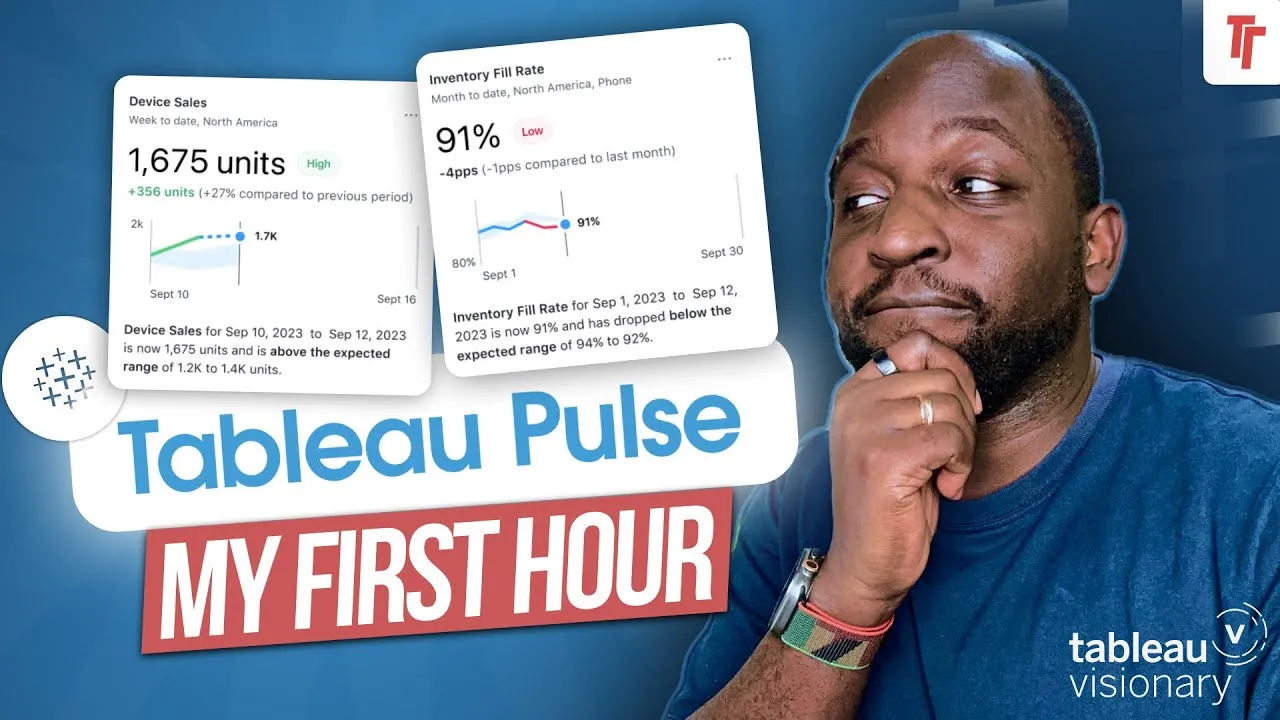
 How Tableau Pulse Works | New in Tableau 2024.1
Pulse splits metric creation into definitions and metrics, and once you grasp that distinction the whole thing clicks.
- Tableau Pulse separates creation into two steps: a metric definition (needing a measure, a time dimension and a data source) and the individual metrics that derive from it with added specificity and segmentation
- Pulse only draws data sources from Tableau Cloud, not Tableau Server, and metrics always base themselves on today's date, so data that doesn't run to the current date shows nulls
- The advanced definition opens a familiar desktop-style editor where you can build calculations (like net subscribers = subscribers gained minus subscribers lost) and exclude data subsets at definition level
- Dimensions added in the definition determine what end users can segment by, so poor upfront data prep (such as uncleansed YouTube tags) produces noisy, near-useless breakdowns
- Pulse generates insights as facts computed from raw data, then summarised by generative AI, and appears to cache results per data source linked to your Tableau Cloud instance
- Pulse leaves beta in 2024.10:00
- Metric definition versus metric1:35
- Connecting a Cloud data source3:12
- Setting measure and time dimension4:10
- Building an advanced calculated metric7:24
- Running totals bug11:37
- Configuring insight behaviour12:51
- Dimensions for user segmentation14:52
- Saving and browsing metrics16:04
- Segmenting and following metrics17:37
- Overview and breakdown views24:31
- Generative AI insights25:30
0:00Hey, it's Tim here. In today's video, I'm
0:01going to show you how Tableau Pulse works.
0:04As ever, let's get stuck in. So we'll start
0:06off right from the back by saying that
0:08Tableau Pulse has just gone into production
0:11as it were. It came out of beta and it was
0:13launched in
0:1424.1. So I'm recording this essentially
0:17almost a week after it's been made public.
0:20I did go
0:20through a long video going through my first
0:22impressions of how it works. If you want a
0:24more
0:24rough cut of how that experience was, go
0:27ahead and check out that video. This video
0:29is going to try
0:29and synthesize everything you need to
0:31understand how Tableau Pulse works. So I'm
0:34going to pick up
0:34from where I left off in my last video
0:36where I showed you just how to enable Table
0:38au Pulse.
0:39Today, we're going to get straight into the
0:41action by going straight into Tableau Pulse
0:43.
0:43As a refresher, you'll see that once you've
0:45enabled Tableau Pulse, you'll see that it
0:47turns
0:47up here on the left-hand side. And when we
0:49go ahead and click on that, it takes us
0:51through to
0:51the experience. So we'll go ahead and click
0:53that and you'll see that we land inside of
0:55Tableau
0:55Pulse. Now there's a couple of things to
0:57bear in mind. I don't have any available
1:00metrics and
1:00there's nothing for me to browse. So this
1:02shouldn't be your first experience if you
1:03're using Tableau
1:04Pulse because in essence, you should
1:07already have metrics available to you. So
1:09the experience I'm
1:10going through today is essentially how to
1:13build those metrics. In another video,
1:15separate video,
1:16I'll go through a more detailed, simpler
1:18video on how to use the metrics if that
1:20makes sense.
1:21So let's just focus today on how to build
1:23the metrics and the metric definitions. And
1:25then
1:26the next video, we'll talk about how to use
1:28them. Okay, so we're here, we've landed in
1:30Tableau
1:31Pulse. I'm a creator, I'm an author, I need
1:33to build metrics for people to use. The
1:35first thing
1:35you're going to notice is there's a nice
1:37big blue call out over here on the right-
1:38hand side to
1:39create a new metric definition. And this is
1:41actually quite important because Tableau
1:43Pulse
1:44breaks down the creation of metrics into
1:46two steps. The first one is the creation of
1:49a metric
1:50definition and the second is the creation
1:52of a metric. And those two kind of happen
1:54in one go.
1:55If I just open up my sidebar here and I go
1:57to this documentation, I'll put a link to
1:59this in
1:59the description. Tableau have actually done
2:01a really good job of detailing this split
2:03here in
2:04this diagram. I actually really like this
2:05diagram. It's a good way to conceptualize
2:07the creation of
2:08metrics, whether or not you're building for
2:10Tableau Pulse or a dashboard, this is a
2:11really
2:12good way of thinking about it. So if you
2:14look at this example, the metric definition
2:16essentially
2:17needs three things. It needs a measure,
2:19some sort of time dimension and the data
2:21source essentially.
2:22And then from that, we're able to add
2:24additional context. So once you have those
2:26three pieces of
2:27information, the additional context,
2:29essentially the step two is defined as a
2:31metric. And for the
2:32metrics, we start to drill into sort of
2:34subsets of that specific definition. So if
2:37you can see here
2:38that down in this metric, we're doing year-
2:40to-date for technology and a couple of other
2:42categories,
2:43and it's essentially still on sales. And on
2:45this one on the right-hand side, we're
2:47still doing
2:48year-to-date, but instead we're doing it
2:49for office supplies. So that is classed as
2:51a separate metric,
2:52but they're all derived from the same
2:54definition. And that's a super important
2:56thing to understand.
2:57So when you go ahead and build for the
2:59first time, think about your definition,
3:01and then you can
3:02enhance that with various metrics that feed
3:04off that original definition. You'll see
3:06this later on
3:07in the video, I'll call it out. But if we
3:09head back to Tableau Pulse, when we go
3:11ahead and hit
3:11the new metric definition, you'll see we
3:13get a list of data sources. Now, in my
3:15previous video,
3:16I highlighted that the data sources you see
3:18here are from your Tableau Cloud instance.
3:21Don't forget
3:22Tableau Pulse is not available for Tableau
3:24Server, so you can't get these from Tableau
3:27Server.
3:27They're only from Tableau Cloud. And I've
3:29actually got a data source which has my
3:31YouTube analytics
3:32that essentially been piped into Snowflake
3:35from Frivetran through the YouTube API. So
3:37we'll go
3:37ahead and click on that and hit connect.
3:39And once we hit connect, we get straight
3:41into the definition
3:42building experience. Let me close my
3:44sidebar so you get a bit more space to see
3:45this. Now,
3:47let me just call out a few things. When you
3:49land in this space, there's two parts of
3:51the journey.
3:52There's the definition, which is what we're
3:54going to do first, and then there is the
3:55insights. The
3:56insights are more of a behavior of how the
3:58metric works with the metric definition.
4:00And so we'll
4:01come to the insights a little later once we
4:03've built out this metric definition a
4:04little bit
4:05more. The next thing you'll see if I just
4:07switch to red here from a highlighter is
4:09the data source.
4:09The data source is essentially what you've
4:11just connected to. And what I will say is
4:13that it's
4:13important to really pay attention to
4:15metadata, I think, in this product because
4:18that information
4:19is used throughout the product to do
4:20different things. So I'm going to call this
4:22subscribers.
4:23And we're going to say that this metric
4:27definition tracks subscribers. Again,
4:29notice my language. I'm
4:31calling this the metric definition rather
4:34than just the metric. So tracks subscriber
4:37change
4:37month to month linked to videos. That's
4:40exactly what this metric does. Sort of a
4:44weird way of the
4:45way YouTube API works. It actually pins
4:47most subscribers to a specific video unless
4:49you just
4:50subscribe out of your own free will. Let's
4:52go ahead and hit full stop on that. And we
4:54've defined
4:55the metric definition. We've defined the
4:57description. Let's have a look at the
4:59measures
4:59here. And so here when we click on the drop
5:01down, you can see it's pulling from the data
5:03source.
5:04And the thing I'm interested in here is
5:05subscribers. So as soon as I start typing,
5:07you can see it searches this. Now for this
5:10particular metric, there's a problem. I
5:12have
5:13subscribers gained. I have subscribers lost
5:15. But what I don't have is a net subscriber
5:17count. So
5:18let me do two things. Let's assume that's
5:20not a problem. Let's just hit subscribers
5:22gained.
5:22And you'll see that it automatically fills
5:25the aggregation and the type of maps that's
5:27going to
5:27work. So you see here running total works
5:30out of the gate and you get non-cumulative
5:32as well there.
5:33And so we can select one of these and you
5:34can start to sort of play around with this.
5:36Now
5:37the key thing you're missing is a time
5:39dimension. Don't forget we needed a measure
5:42, a time dimension,
5:43and then a data source. We've got a data
5:44source. We've got a measure. The last thing
5:46is a time
5:47dimension. So for this, this is actually
5:50linked to the date that the data is being
5:52collected on. So
5:53if I select that date, as soon as we give
5:54it all three pieces of information, we
5:56immediately get a
5:57metric applied. Now again, notice I said a
6:00metric because what is strictly happening
6:04here is that
6:04this on the left hand side is your
6:06definition and this on your right hand side
6:09is actually a metric.
6:11It's just lacking some sort of specificity,
6:13if that makes sense. The specificity we
6:17have at the
6:17moment is month to date. You could choose
6:19another time context, but month to date is
6:22the default
6:22context. So it's sort of an interesting one
6:25because you have this sort of unified
6:28interface,
6:28but you have to really remember that on the
6:31left hand side you're dealing with the
6:33definition,
6:33on the right you're dealing with the metric
6:35, and those two are not the same. I'll
6:37explain why that
6:38is the case later in this video, so please
6:40bear with me and you'll see why this is an
6:42important
6:42thing to understand. Okay, so now that we
6:45've done this, we can go down and you can
6:47see you get a few
6:48other options and you can kind of get the
6:50gist of how this works. It's actually quite
6:52easy to set up
6:52the metric. That is it, that's done. I mean
6:54, I didn't even sort of celebrate that that
6:56's how easy
6:57it was and it really was that easy and I'm
6:59not just a fanboy here, just a championing
7:02tableau.
7:03This is really a very accessible way of
7:05creating metrics in a quick digestible
7:08manner. Now,
7:10remember earlier on we said we had a
7:11problem and this was with this metric,
7:13subscribers gained
7:14and subscribers lost. What I'd actually
7:16like to do is to create a new metric here
7:18called
7:18net subscribers, but you'll notice there's
7:20no interface for me to do a calculation
7:22just yet. So
7:23in this value area here, if you scroll down
7:27, because this right hand space is the
7:30definition,
7:31one of the things you can do is you can
7:33create what's called an advanced definition
7:35. You can
7:35see that right here, okay, and if we go
7:38ahead and click on that, what it does is it
7:40takes us to
7:42something very familiar to desktop creators
7:44and that is the ability to just go into
7:46tableau and
7:47build your metric. You'll notice that my
7:49data source is actually a data model across
7:50two data
7:51sets and I can go and access every single
7:53field as I would do and the way this works
7:56is very similar
7:57to the experience you get with published
7:58data sources in web authoring. You're
8:00essentially
8:00able to go ahead and create your published
8:02data source. You can kind of model what you
8:04're looking
8:04at here on the right hand side in the
8:06canvas, but it never creates those charts.
8:07It's just sort of
8:09an area where you can model things. So what
8:11we can do here, we can create a calculation
8:13and we can say sum of subscribers gained
8:19plus, sorry, minus sum of subscribers lost
8:25and now that we've done that, we can call
8:28this net subscribers, okay, and we'll give
8:33that a bit of
8:34a space there. Net subscribers, that is our
8:35metric, that is a much better way of doing
8:37this. We'll hit
8:38apply and hit okay and you'll notice
8:40nothing has changed because we've just done
8:43what we do in
8:44desktop. We've created a metric down here,
8:47okay. Now to build that metric, notice the
8:50same three
8:50things that we needed before are also
8:52present. We already got the data source,
8:53that's part of
8:54the definition. What we now need to add to
8:56this view is the measure and the time
8:58dimension. So go
8:59ahead and let's drag the net subscribers to
9:02the measure and you'll see that we
9:04immediately get a
9:05bar chart telling us something, so 3000 and
9:08if this is all we did, the metric would
9:10just track
9:10this number. This is not a good reflection
9:13of my actual subscriber count because the
9:15data source
9:16only goes back a bit of a few months
9:18because of the way that 5tran and YouTube
9:20API work.
9:21So let's go ahead and grab a date and the
9:24date we want here is date today and just
9:27like you can do
9:28in Tableau, you can choose the context for
9:30that date. So rather than the year, I'm
9:32actually going
9:32to go back down here and choose a
9:34continuous day if that makes sense. So we
9:37get a day by day blow
9:38of that and there you go, that's something
9:40a little bit more familiar. Now this chart
9:42is a
9:43representation of what's driving the pulse
9:45metric but it's not actually the pulse
9:47metric,
9:48it's just a visual way for you to see some
9:50context. So what do we do from here? Well,
9:54we can go ahead and hit apply and before I
9:56actually do that, notice that you can sort
10:00of
10:00do some filtering on this metric in here
10:03and this is not the same as letting users
10:06choose the
10:06filtering if that makes sense. So a good
10:08way to think of it is if I was building
10:10this advanced
10:11metric and what I wanted to do is exclude
10:14certain videos or exclude certain subsets
10:17of my data from
10:18being part of this metric, I could actually
10:20do that here in the advanced element. So I
10:22can go
10:23ahead and get the video title. Let's say
10:27that I didn't want a specific video to
10:29contribute
10:30to this. Let's say as I go to what is Table
10:33au, the reason I might exclude this is
10:36because
10:37this is the biggest video on my channel so
10:40it has a rather large skew on what's going
10:43on. So if I hit
10:44okay and we say exclude and we hit apply,
10:46you'll see in the background the metric
10:48changes but the
10:49biggest change was actually in the axis and
10:51you can see that that's now taken into
10:52effect and as
10:53soon as I remove it my metric sort of adapt
10:55s to adjust for that. It's a very slight
10:58change but
10:58in the more recent months it hasn't had a
11:00bigger impact, in the previous months it's
11:02like 50% of my
11:03channel grade. So we'll just leave this at
11:05this and we'll hit apply. Now when you hit
11:08apply you
11:08get a reminder about your selections. This
11:11is because if you don't do all these three
11:13things
11:13you'll get an error so this is like a nice
11:15way of reminding you that this is what you
11:17need. We have
11:17all of these, we have a measure, we have a
11:19time dimension, we don't need filters, it's
11:21optional,
11:22so we'll hit apply and that is how you get
11:24around that problem of being able to create
11:27a metric from
11:28a calculation inside of this window and you
11:30'll see that this is now a little bit better
11:32, it's a
11:32little bit clearer and we get a better view
11:34of what's going on. Now one thing I didn't
11:36touch on
11:37in that step is that we have a bit of an
11:39issue with running totals inside of that.
11:42If I go to
11:43replace advanced definition and instead of
11:45the standard measure I've got here I'll go
11:48and do
11:48running total, you'll see that it generates
11:51a running total fine but if I hit apply and
11:53I hit
11:53apply again I get a bug and I don't know if
11:55this is an issue just because it's out of
11:57the gate but
11:58I've had this sort of bug consistently
12:00since I've been using Tableau Pulse and
12:02admittedly it's only
12:03been public for one week so I'm sure this
12:05will get fixed but nonetheless I just
12:07wanted to call that
12:08out if you're having that experience. Okay
12:10so let's go ahead and undo that change, let
12:12's go
12:12ahead and remove the running total and hit
12:15apply and now if we hit apply again you'll
12:17see it
12:17magically works there's no problem now and
12:20we get back. So that is our advanced
12:22definition now.
12:23The way the measure works you kind of get
12:25some nasty sort of Tableau stuff in the
12:27background,
12:27you'll see there that it doesn't call it
12:29what I called it which was net subscribers
12:31it calls it
12:32calculation 105 whatever so that's always
12:34something that happens sometimes if you
12:36look in the Tableau
12:36Workbook XML you can see that kind of
12:38coming through here in the product but
12:40nonetheless
12:41just be aware that these are just sort of I
12:43guess sort of rough edges that will get
12:44smoothed out
12:45over time but nonetheless the metric is
12:47working fine. The second part of this is
12:50then telling
12:51Tableau Pulse how to interpret those
12:53insights and this is the easiest part to
12:55miss I believe because
12:56you can go ahead and hit save definition
12:58but I think you have to get into the habit
13:00of going
13:00into the second tab because if you go into
13:02the second tab you'll notice that there are
13:05no
13:05insights to preview right now what's
13:06happening is in the background Tableau is
13:08already processing
13:09this information so we'll go ahead and it
13:11will do this quite quickly and we'll be
13:13able to come back
13:14to this and look in the future but you can
13:16tell Tableau here what happens when the
13:18value is going
13:19up. Obviously what happens in the other
13:21direction is implied so we don't need to
13:23always specify that
13:24but nonetheless you can tell if going up is
13:27favorable which it is in this case and you
13:30can
13:30also change the insight type so you get
13:32these several insight types here so you've
13:35got five
13:36six insight types and you get a little bit
13:38of a description of what's going on and the
13:41different
13:41types of insights that you can get and you
13:43can disable certain ones if that insight
13:45type doesn't
13:46work you can disable them you can just
13:48change them and switch them off so you do
13:50have a bit of
13:50control into that. Now if we go back into
13:53the definition what I want to do is finish
13:56building
13:57this metric because once we finish defining
14:01the definition everything else defines
14:05additional
14:06metrics okay so it's not super clear to me
14:09but I sort of figured this out over time
14:12these options
14:13down here kind of drive that behavior so
14:15the number format is just a general sort of
14:18description
14:19of the number and if you click on this you
14:21do get the ability to change to currency or
14:23percentage
14:24and you can you can kind of use a
14:26description so we can say unit expression
14:30singular so you can say
14:31subscriber and we can say here subscribers
14:36and that is it and now you'll notice that
14:40nothing
14:41nothing really changes here nothing really
14:43changes in the definition I think this will
14:44have a sort of
14:45a big play further down the line that this
14:48bit here this is where I think stuff really
14:51matters
14:51because the dimensions you add here end up
14:54being what end users can use to customize
14:57their metrics
14:58essentially so the definition you give has
15:00to include these dimensions otherwise users
15:03can't
15:04really build segmented metrics for
15:05themselves for example if I was using super
15:08store I couldn't use
15:09the categories to generate a metric for
15:12each category so in my case I will use a
15:15video title
15:16because I want to be able to create metrics
15:18for a specific video I might also use other
15:21information
15:22about the channel so I might say as a very
15:25simple example the channel title if I was
15:29tracking
15:29multiple titles I might also use let's say
15:32tags and tags are something that I think we
15:36do get in
15:36here I don't know why I'm scrolling down I
15:38can just go I can just go and search these
15:41things
15:41and then the final thing I might want to do
15:44I think that's honestly enough actually
15:47those those
15:48those are enough to show you what's
15:49happening and you can see that they get
15:51added here at the top so
15:52you can kind of think of everything that I
15:54'm sort of circling in this blue box as
15:56being part of your
15:58metric definition and your metric control
16:01all in one package and as soon as you're
16:03done we can go
16:04ahead and hit save let's hit save
16:06definition and here we are we've built our
16:09metric definition and
16:10the first thing you get is actually a
16:12metric out of the get and you can see it
16:14immediately has
16:15insights and I think that's a super
16:17powerful thing here I've just added the
16:18data source and the value
16:20comes out of the system straight away I can
16:22immediately start working with this I don't
16:24know
16:24if it processes it in the background and in
16:26the time I've taken to sort of talk to you
16:28it's done
16:29it but nonetheless um it's here now I will
16:32use this opportunity to just send a bit of
16:34feedback
16:35to tableau this back button it's it's wild
16:38because in this particular instance it
16:42sends you back to
16:43the metric definition it's always
16:45contextual to where you've just come from
16:48which means depending
16:49on where you are across the whole of table
16:51au pulse that back button can mean different
16:53things
16:54I initially thought this back button was
16:56going to go to tableau pulse the landing
16:58page so I could
16:59see all my other metrics but you'll see
17:00that if I hit back it goes back to the
17:02metric definition
17:03and it asks me to select the data source
17:06which is which is slightly odd I just didn
17:08't expect it to
17:09go right to the beginning of the previous
17:11experience if anything I would expect it to
17:13go
17:13back to the editing experience of the
17:15metric I've just created nonetheless um
17:17this is slightly odd
17:18and it can leave people confused and
17:20thinking hey what happened and when you hit
17:22close you go back
17:23to tableau pulse and you're landing on this
17:25page and you're like hey where's the metric
17:27I just
17:28created it's not here so here's the thing
17:30the metrics you've just created you've not
17:34yet had
17:34a chance to follow said metrics so if we go
17:37to browse metrics you'll see that that
17:39metric is
17:40indeed there if I click on it I do actually
17:42get to see this and remember earlier on
17:44when I said that
17:45you create your definition and your first
17:48definition you get a free metric with it
17:50essentially that first metric is the same
17:52as the definition without any segmentation
17:55so
17:55what does that mean well let's go to this
17:58metric and let's add some segmentation and
18:00you'll see
18:01how you can save additional metrics having
18:03defined them so we'll go ahead to this we
18:05'll hit adjust
18:06and then we can go ahead and start
18:08searching for specific things so if I want
18:10to find all my videos
18:11that say tableau pulse um you'll see that
18:14it's able to go through and we can go ahead
18:18and just
18:18tick all of these um and we'll hit okay
18:21these are the five so those five videos are
18:23specifically
18:24about tableau pulse and they're all from my
18:26channel there's nothing special there
18:28unfortunately um I'll come back to this
18:30point later but if you've not done your
18:32data prep it
18:33will show here so the tags are not in the
18:35format I was expecting I was expecting them
18:38to be sort
18:39of separate items but they're all just sort
18:41of everything I put into that space in
18:43youtube so
18:43it's not perfect but nonetheless we won't
18:46use that um I can choose different contexts
18:48of time as well
18:49this is super important depending on the
18:51context you have you can choose week to day
18:54and you know
18:54this changes the metrics so as soon as I
18:57hit this um tick what that does is it saves
19:01an instance of
19:02a metric and you'll see in the last week
19:04nothing has happened and a lot of you will
19:05see this the
19:06first time you use tableau pulse because
19:08your data has to be running to today's date
19:11if you look at
19:12this tableau pass is always basing itself
19:14on today and if your data doesn't have
19:16anything today this
19:19is what you'll see however if I go back and
19:21I adjust this metric let's say we don't
19:23want to do
19:24week to date let's do month today and we
19:26hit plus then you'll see that we do get
19:28some information
19:29back and it stops right here okay and this
19:32is this is super useful because um I spent
19:37about five
19:37minutes for the first time just trying to
19:39understand what was going on and I couldn't
19:41figure it out and
19:42I realized oh it's because there's no so
19:44there's no there's no data in the context
19:46that I have so
19:47here we have the information these are just
19:50the videos related to tableau pass so over
19:53the last
19:53month and there are about 22 subscribers
19:56who've come from videos relating to tableau
19:58pass
19:59now we've done this a couple of times we've
20:01created variations of this metrics a couple
20:03of times so let's go back and again when
20:05you hit back this time it takes you
20:08somewhere different
20:08to where I'd expect notice that rogue
20:10instance where we created a metric that
20:12didn't have
20:13anything in it that was instantiated
20:15immediately you didn't have really an
20:17option to save it or
20:18delete it and that's been created and the
20:20most recent one we created is also here so
20:2222 here as
20:23well so there's a little bit of house
20:25keeping you have to do if you're just busy
20:26clicking these
20:27metrics and not sort of paying attention
20:29you can come back here and find you've got
20:31three or four
20:31metrics you didn't intend to have so you
20:33can obviously manage those by just going
20:35here
20:35seeing the details and as soon as you go to
20:38the details you can go back in there and
20:40actually
20:41go ahead I thought you could delete them
20:43here but actually that's wrong um what am I
20:46what am I
20:46missing here um okay I thought you could
20:49delete it here maybe I'm missing something
20:52I could swear
20:53I found a way to delete a metric but maybe
20:55I was deleting metric definitions um so um
20:59maybe this
21:00will come back to me but I hope I hope you
21:02can delete these rogue ones because you saw
21:05how easy
21:06it was for me to create this null metric
21:07and they're kind of frustrating as well
21:09because they
21:09don't need to get experience and if they're
21:11discoverable then hey you don't want people
21:12to be seeing these but nevertheless um this
21:15is this is sort of the experience now let
21:17me go
21:18ahead and hit follow on these two and if I
21:20go back to the Tableau pass landing page by
21:22hitting that
21:24you'll see that those two metrics I created
21:26now land here on my landing page so we've
21:29got these
21:29nice metrics available to us here and we
21:32can kind of just get using them so if I go
21:34back into the
21:35subscribers this is it this is how it's
21:37working now at any point if you want to
21:39change this if
21:40you want to play around with this if you
21:42click on these three dots at the top you
21:43always get the
21:44option to edit the definition and that
21:46takes you back to this experience and you
21:48can obviously go
21:49back and change the insights and when you
21:51do this it changes the context each time
21:53this is also a
21:54good place to go back to this insights tab
21:55and show you that now it's generated some
21:58context and
21:59what these really lend themselves to are
22:01the different types of insights the Tableau
22:02pass can
22:03generate we've already been going for 20
22:05minutes here so I don't want to make this
22:06video longer by
22:07going into the different types of insights
22:09you can get I'll do this in a separate
22:11video but just be
22:12aware that there's a broad range of insight
22:14types and they generally map to these ones
22:16that you can
22:16see here but in terms of how they play out
22:19and it probably helps to be able to see how
22:21those
22:22interactions work so I'll come back to that
22:24a little later the other thing I'll also
22:26highlight
22:26as I sort of scroll up and down here is
22:28that look if you've not done your data prep
22:30up front this is
22:31just still not going to give you nice
22:32results you can see here that the tags the
22:34tags are just
22:35causing so much noise in here and there's
22:37valuable information because I use these
22:39tags on videos
22:40where it makes sense but there's just they
22:42're just not being cleansed properly so what
22:44I would love
22:44to do is to have a way of being able to use
22:47this information and just pass this out so
22:50Tableau can
22:50understand that although these are lists
22:52actually all we care about is the items in
22:54each of these
22:56in each of these sort of list of values
22:58arrays of values as it were if you're a
23:00programmer so
23:01it's just a little bit something sort of to
23:03bear in mind if you're if you're not doing
23:05your data prep
23:06up front you're gonna have to do it in
23:08Tableau prep Tableau desktop in your data
23:10source or do
23:11it back further back somewhere more
23:13observable in something like dbt or in a
23:15data engineering
23:16operation that you're that you're running
23:18okay the other thing I have to say about
23:21this if I just go
23:21back and save this we'll just save this as
23:24is we haven't really changed anything is I
23:26would like
23:27the ability to be able to put what I would
23:29call the wild card in here that updates as
23:31a data update
23:32so at the moment you can see the video
23:35title here I can go ahead and type you know
23:37Tableau desktop
23:39and all the videos related to Tableau
23:41desktop come up now the problem is is you
23:43know when I when I
23:46deselect one it deselects and if I hit
23:49exclude it excludes all of them so if I do
23:52exclude and then
23:53I just sort of delete this you see that it
23:55says that all of them have been excluded so
23:58there's no way for me to do like a wildcard
24:01search on the data set if that makes sense
24:03there's no way
24:04for me to say anything that mentions this
24:06specific term always added to this metric
24:09because then I
24:10think that makes metrics a little bit more
24:12meaningful and it makes these drop downs
24:14actually represent what we can do already
24:15inside of Tableau today so that would be
24:17one additional thing I'd love to see in the
24:19future but nonetheless I'm not going to
24:21create a new
24:21metric I don't want to create more noise
24:23right the very final thing I know we've
24:25been going for some
24:26time we're nearly 30 minutes in is at this
24:28section here this is where really the magic
24:30starts to
24:31happen if we spend a bit of time just
24:33working with this metric you can see that
24:35obviously we've got
24:36the overview and the breakdown in here and
24:38if we go to the breakdown we actually get a
24:40little bit
24:41more of a detailed breakdown and you can
24:42see this is a genuine reflection of my
24:44channel the Tableau
24:45desktop crash course is driving a good
24:47number of subscribers each month and if we
24:50sort of go down
24:51the list other videos have a slightly
24:53smaller impact but nonetheless this is very
24:56representative
24:57of what I know and what works if I select
24:59video tags though you can see the tags
25:01again are a bit
25:02noisy and this makes us basically pointless
25:04because a large bunch don't have a value
25:06and the rest are
25:07just I mean what can I really do with that
25:09okay there's not much it's too much
25:11information
25:11I'll get back to the overview you can
25:13obviously hover over this and work with it
25:16which is quite
25:16nice and I like the fact that this is
25:18contextualized I do need to get my data
25:20source to update a little bit so there's a
25:22little bit of an issue with my sort of data
25:23pipeline in
25:24the background but here's the next really
25:27sort of exciting things this section here
25:30is where the AI
25:32comes in so they call it GAI so generative
25:36AI right these questions are part of a sort
25:39of a
25:40system that Tableau's built where
25:42essentially the way that the platform works
25:45is the insight is
25:46actually generated from your raw data that
25:48is just just think of it as maths being
25:51done on your data
25:52and essentially those are facts those facts
25:54are then presented in order of preference
25:56in order of
25:57sort of what's working and what's not and
26:00then once that's done it's summarized by
26:02generative AI
26:04and then what you get back is essentially
26:06these these sentences and these sentences
26:08are a good way
26:09of helping the user go to the next question
26:12understand what's going on and so the
26:14computations
26:15that drive these questions have already
26:16been done in the background but what these
26:18questions are is
26:19sort of tempting you to explore those
26:21journeys take those journeys with your data
26:24so if we go
26:24ahead and say okay which video title
26:26decreased the most which video title had
26:28the most negative impact
26:30on my subscriber count you can see here
26:31that it's actually what is Tableau and this
26:33makes sense
26:34because the way you have to think of this
26:36metric is that the metric isn't about which
26:39video lost me
26:40subscribers remember our metric was
26:42actually net subscribers it's not
26:45subscribers lost it's
26:46subscribe it's not subscribers gained it's
26:48net subscribers so I could go ahead and
26:50recreate this
26:51with subscribers lost and this sentence
26:53would make more sense but all it's saying
26:55is that I got 19
26:57less subscribers this month compared to
26:59last month for this particular video okay
27:01and it gives us a
27:02nice sentence that actually breaks that
27:04down a little bit and remember all the
27:05terminology we
27:06did before for singular versus plural that
27:09's all in here that's all being used to kind
27:11of make this
27:11work really really well and as we click on
27:14these uh notice every time I click on
27:16something here
27:17it gets added just below here okay so let's
27:20go ahead and see which video title had high
27:22subscribers
27:23so let's go ahead and hit that again you
27:25get the Tableau desktop crash course you'd
27:26already seen
27:27that and as you click on these the metrics
27:29sort of go down so I can kind of just click
27:32on these
27:32and you'll see that all the metrics sort of
27:34come through and remember some of these
27:36were some of
27:36the noisy ones we were seeing on the
27:38insights tab before so that was already a
27:40preview of what you
27:41were going to see and it's essentially just
27:43enabling and disabling them behind the
27:45scenes so
27:46it's a pretty good platform and you know my
27:48data is pretty simple I'm just tracking one
27:50thing
27:50subscribers but in Superstore and in other
27:53data sets you might have slightly richer
27:55context that
27:56you can work with one thing I will say if
27:57you're working with Superstore make sure
27:59you shift the
27:59dates to the last day is actually today
28:02because if you don't do that you'll see
28:04null for quite a lot
28:05of the Superstore data because it stops at
28:07a certain point in time depending on the
28:08Tableau
28:08release so let's go back that is that is
28:11pretty much the whole entire experience in
28:14a nutshell
28:14that is how to use the the the platform
28:17what I will say is this if I go back to the
28:19Tableau
28:20past landing page now that I'm here you'll
28:23notice that this summary here at the top is
28:26being
28:26generated so it kind of tries to pull out
28:28the most important things happening so it
28:30says this month
28:31there is a 5.9 percent decrease in
28:34subscribers um based on this video so what
28:36is Tableau explained
28:37in under 10 minutes basically it's saying
28:39hey there's a there's a six percent
28:40decrease in this
28:41one video compared to last month however
28:44there is a significant increase 28.3
28:46percent in overall
28:47subscribers compared to the same time last
28:50month so in broad brush terms I'm doing
28:52well but being
28:54specific there's one video that's got an
28:56impact so I might choose to go and analyze
28:58that I might
28:58choose to go and do something else now
29:01unlike other features in Tableau these
29:04thumbs up and
29:05thumbs down help improve the system Tableau
29:07is using these as prompts to try and
29:09understand what
29:10people are interested in and what they're
29:12not so if I say that this is this is good
29:14um you can
29:14obviously send that feedback to Tableau I
29:17won't bother here but um what this will
29:19help you do is
29:20try and understand what's going on the
29:22other thing to bear in mind you'll see this
29:25says it was last
29:26updated 12 hours ago and that's because I'd
29:28already created this data set whilst doing
29:31a demo so
29:31this this sentences this sentence suggests
29:34a couple of things and it's sort of a
29:36really intriguing
29:37fact about Tableau Pulse and how it's
29:40working behind the scenes 12 hours ago I'd
29:44just finished
29:45recording what was the third take of this
29:48video right and what's ended up happening
29:50is it somehow
29:51cached that data source and it's remembered
29:53that it's seen this in this data source
29:55before
29:55likely because it's linked to my Tableau
29:58cloud instance so rather than regenerating
30:00all the
30:00insights it actually found that it already
30:02generated them and is simply serving them
30:04up
30:04from the cache even though you've watched
30:06me create these metrics for the first time
30:08and
30:08add the data source for the first time to
30:11Tableau Pulse whilst doing this so it does
30:13suggest a
30:14little bit of caching a little bit of what
30:15I would suggest sort of frequency in which
30:17it's going to
30:18be updating these metrics based on how
30:20often the data source is updated so if the
30:22data source isn't
30:23updated I don't expect this to change but
30:25if it's updating frequently then I would
30:26expect Tableau
30:27Pulse to hopefully pick up on this
30:29frequency anyway these are small nuances to
30:32bear in mind
30:32as we start to get to know this feature a
30:35little bit more but nonetheless I think
30:37that is pretty
30:38much all I want to cover today we've been
30:39going for a long time 30 minutes it's a
30:41really long
30:41time for a video I really do thank you for
30:43watching this if you've watched it all the
30:45way through
30:46let me know what feedback you have about
30:49this video about the feature below I do
30:53know the
30:53Tableau product team do see the comments so
30:55go ahead let them know what you think save
30:58me the
30:58the sort of job of having to summarize it
31:00for them but the other thing to bear in
31:02mind here is there's
31:03so much more to discover so if you've
31:04discovered something you find it super
31:05useful if you've got
31:06some questions and you'd want to sort of
31:08find out you know how to how to how to
31:10execute that
31:11let me know in the comments below we'll try
31:13and see what we can do in the coming days I
31:14need to
31:15spend a bit more time generating a bigger
31:17range of metrics and a bigger range of
31:19insights so I'm
31:20slowly working through building a bunch of
31:22data that are going to slowly update over
31:24time and we're
31:25going to try and use Tableau Pulse to see
31:27how well it passes out some of that
31:28information that's super
31:30important in this particular case because I
31:32think this is a new feature it's going to
31:34have a lot a
31:35lot of sort of strange edges and rough
31:38edges that we need to sort of iron out the
31:41last thing I'll
31:42say though is that at least on this release
31:45now that it's public there are a few
31:47features missing
31:48from Tableau Cloud that I would have
31:49expected to be in here specifically if you
31:51're paying for
31:52something like a data management add-on I
31:53would have hoped to have seen more
31:55information about
31:56lineage if I go to a metric for example I
31:59would really hope that once I'm here I
32:02start to see a
32:03little bit of information relating to
32:05lineage maybe some charts and dashboards
32:08that use the
32:08related metrics so that I can go off and
32:11see the same context inside of the Tableau
32:13Cloud world now
32:14I do know that it's a deliberate choice by
32:16Tableau to make Tableau Pulse a separate
32:18experience so it
32:19doesn't have to be encumbered by all the
32:21effort and all the sort of legacy that is
32:23Tableau Cloud
32:24and Tableau Server but at the same time I
32:26think it's a normal expectation especially
32:28in the most
32:29recent years where Tableau and have been
32:31really pushing the data management add-on
32:33to lots and
32:34lots of customers to really bring that
32:35value through to new platforms otherwise it
32:38does sort
32:38of beg the question of you know you know
32:40when you when you subscribe to these things
32:42how secure is
32:43your investment if they're not being pulled
32:45through to new features you know if you'd
32:48used
32:48ask data or metrics in the past and you've
32:50spent the last three years finding a sweet
32:52spot where
32:52these work great I do think Pulse is a
32:55better product than metrics definitely but
32:57all the less
32:58you know the time you've invested in that
33:00kind of you know doesn't really pay off
33:02here it's a
33:03completely different experience you have to
33:05reset your expectations you have to rebuild
33:07you the way
33:08it works the other final thing is that we
33:11will do a video on how to use this as an
33:14end user some of
33:15the feedback I get is that look a lot of my
33:16videos are great for authors but what about
33:18just end users
33:19who don't care about building these things
33:20I'm just going to come and use these
33:22metrics we'll do
33:23a dedicated video on that just to make it
33:24easy for everyone to be able to share that
33:26as well okay
33:27we've been going for long enough and I
33:29really hope I haven't missed anything that
33:31's sort of my biggest
33:32nightmare this is the fourth time I've
33:34recorded this and so I think I've done it
33:36in a much more
33:37logical order this time around so this is
33:39just you know an honest honest experience
33:42let me know what
33:42you think let me know if there's anything
33:44missing whatsoever we can cover it later on
33:45this week
33:46as ever thanks for watching and I'll see
33:48you in the next video
33:49you
33:49you
33:59[ Silence ]
Tableau Pulse splits metric creation into two linked steps – a metric definition and the metrics derived from it – and understanding that split is the key to using it properly, including its calculation editor, insight configuration and generative AI summaries.
Tim connects a Tableau Cloud data source containing YouTube analytics (piped via Fivetran into Snowflake) and builds out subscriber-tracking metrics in Tableau Pulse, following on from an earlier first-impressions video.
- Definition vs metric: the core split 1:35
A metric definition needs three things: a measure, a time dimension and a data source. Once those exist you automatically get a first metric, and any additional metrics you build later add specificity (filters, segments) on top of that same definition.
- Connect a Cloud data source 3:12
Pulse only pulls data sources from Tableau Cloud, not Tableau Server, so this must be the starting point. You must supply a measure and a time dimension before Pulse treats what you've built as a usable metric rather than an incomplete definition.
- Set the measure and time dimension 4:10
Pick the measure you want to track and a date field as the time dimension; Pulse auto-suggests sensible aggregation types (e.g. running total) once it recognises the field. Metrics always anchor to today's date, so if your data doesn't run right up to the current date you'll see nulls rather than a broken metric.
- Build calculations in the advanced definition 7:24
If the measure you need doesn't exist yet (like a net figure from two raw fields), open the advanced definition editor — a familiar desktop-style calculation environment where you can build formulas and also exclude specific data subsets at the definition level, which affects every metric built from it, not just one view.
- Configure how insights are interpreted 12:51
On the second tab you set things like whether an upward trend is favourable and choose which of the several insight types to enable or disable, giving you some control over what Pulse tries to surface without having to accept every generated insight.
- Choose dimensions for user segmentation 14:52
Dimensions added at the definition stage become the only fields end users can later segment metrics by, so this step matters more than it first appears. Messy source data (like uncleansed tags) carries straight through into noisy, near-unusable segment options for anyone downstream.
- Save, browse and segment metrics 16:04
After saving a definition you land on a metric that's essentially the definition with no added specificity; from there you can create further metrics by filtering to a segment (e.g. specific videos) and choosing a time context such as week-to-date or month-to-date. Be aware navigation can leave orphaned or empty metrics behind if you experiment casually.
- Generative AI summaries and insight caching 24:31
Pulse computes insights as facts from raw data (essentially calculations) and then has generative AI turn them into readable sentences, using the singular/plural and formatting terms you set earlier in the definition. It appears to cache these results per data source tied to your Cloud instance, only refreshing when the source itself updates.
- Pulse is Tableau Cloud only — you can't source metrics from Tableau Server
- Metrics always calculate against today's date, so data that doesn't extend to the current date shows nulls rather than an error
- There's a bug where replacing the advanced definition's measure with a running total and applying twice can break the metric
- It's easy to create empty or duplicate 'rogue' metrics by clicking through options without realising, and there isn't an obvious way to delete them
Reach for this once you already have metrics you want to expose to business users for self-serve segmentation and AI-narrated summaries — it's not the tool for your first Tableau Pulse experience, since someone still has to design the definitions properly first.
How this Rollup was made provenance & method ▸
A Rollup is drafted by AI from the video's transcript, then reviewed and edited by Tim. Everything used to produce this one is listed below (the model, the exact prompt, and the source video), so the process is transparent and reproducible.
- Transcription
- On-device: NVIDIA Parakeet v3 for recent videos, OpenAI Whisper large-v3 for earlier ones. The transcript never leaves the machine or gets published.
- Drafting
- Claude Sonnet 5 in the cloud, from that transcript.
- Prompt
- The exact Rollup prompt (v2) ↗, the full system prompt, unedited.
- Mode
- Walkthrough: a timestamped breakdown in video order, for a demo or how-to. Written before modes existed, when every Rollup was a walkthrough.
- Source video
- Watch on YouTube ↗
- Drafted
- 5 July 2026 at 09:38
- Reviewed & edited
- 11 July 2026 at 12:23 · by Tim Ngwena
Model + prompt + video is everything you'd need to recreate a Rollup like this yourself. The one thing we don't share is the transcript.
Rights. The video and its transcript are the property of TN Media Ltd. Unauthorised use or download is prohibited. © TN Media Ltd.