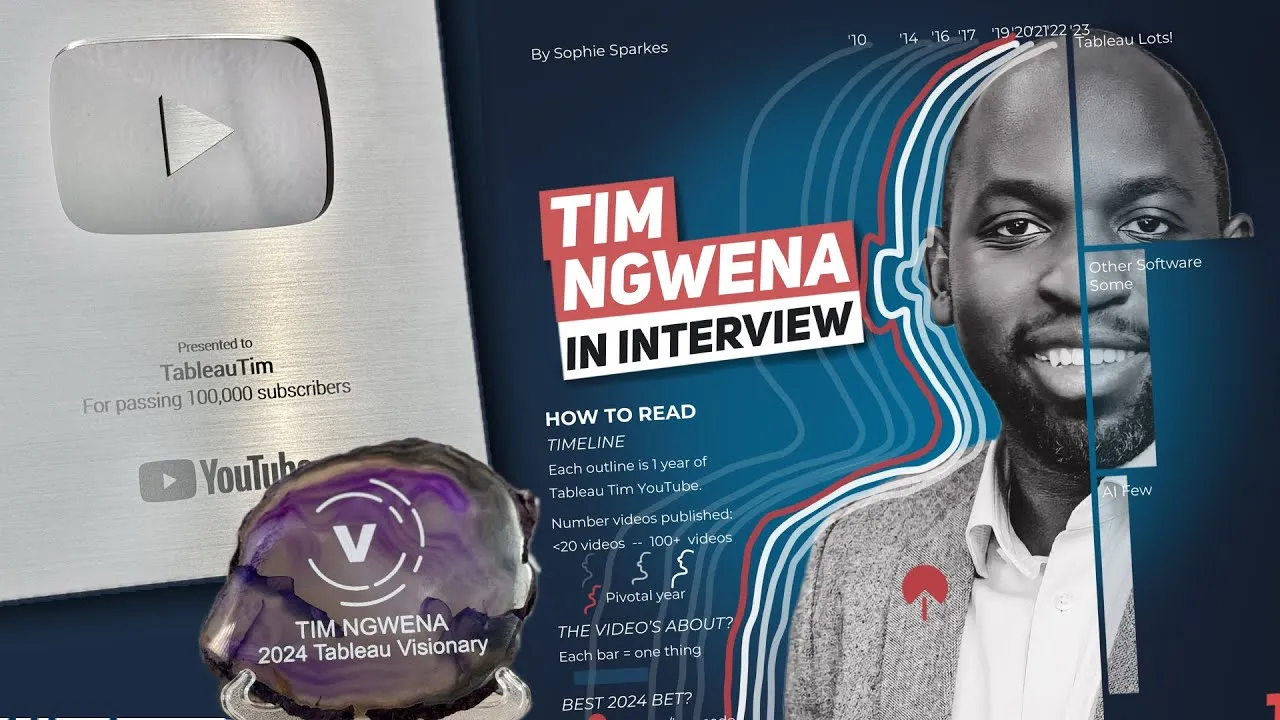
600 Vidoes! - Find out why the channel is dying
600 videos in, I'm opening the back end of the channel to show you exactly why it's slowly withering — and why beginner content is the only thing that still works.
- Roughly 80% of a video's views come from YouTube's own recommendation and search engine, so sharing on LinkedIn or Twitter has next to no impact on reach.
- Of 821 views only about 600 were monetisable, and the channel earns roughly £6.70 per thousand views while advertisers pay around £25 per thousand — YouTube keeps the lion's share.
- Beginner content like 'What is Tableau' dramatically outperforms advanced deep dives, which punishes channels covering niche 'what's new' updates.
- AI now auto-translates titles and descriptions into many languages, but it does not change how the recommendation algorithm distributes the video.
- Paid promotion experiments showed 20 million impressions generating only a few hundred thousand views and modest subscriber gains, explaining the channel's irregular subscriber spikes.
Tim opens up the back end of his YouTube channel to show, honestly, how the analytics, revenue and algorithm mechanics actually work — and why a niche advanced-content channel like his naturally withers while beginner-focused content keeps winning.
Recorded to mark 600 videos on the channel. Tim walks through YouTube Studio's own dashboards using his real numbers, rather than a hypothetical example.
- Where views actually come from 7:51
Roughly 80% of watch traffic on any video comes from YouTube's own recommendation and search engine, not from external links. Sharing a video on LinkedIn or Twitter has next to no impact on reach compared with what YouTube itself pushes.
- How revenue and RPM really work 11:24
Not every view is monetisable — of 821 views only around 600 counted, partly due to ad blockers. Advertisers pay roughly £25 per thousand views, but the platform keeps a large cut, leaving the creator with a much smaller RPM, similar to a publisher taking a cut of book sales.
- AI translation widens reach but not distribution 14:32
YouTube auto-translates titles, descriptions and sometimes voice into other languages when it's confident the quality is good enough, which can expose a video to a much larger non-English audience. This doesn't change how the recommendation algorithm decides who to show the video to in the first place.
- Consistency and life circumstances shape growth 15:59
YouTube's algorithm rewards metronomic, consistent posting, and gaps caused by personal or professional disruption show up directly as dips in the channel's long-term view and subscriber trends. Momentum lost after a break is hard to fully recover.
- Demographics and device data shape content decisions 24:59
Studio shows where your audience is, what device they watch on, and their self-reported age and gender — useful for understanding who you're actually making content for. Desktop viewing tends to dominate for longer-form tutorial content, while mobile is where short-form content performs.
- Memberships are a small, low-effort supporter tier 31:22
Channel memberships work like a low-cost Patreon or newsletter subscription, offering a couple of low price tiers. Once membership tiers are approved they're difficult to change, so it's worth setting them up carefully from the start.
- Paid promotion has a low, patchy return 34:07
Promoting a video to millions of impressions produced only a small fraction of views and a modest number of new subscribers, explaining the irregular subscriber spikes visible in the channel's history. Return on ad spend varied a lot between videos, so it's not a reliable growth lever on its own.
- Why beginner content wins 39:08
Beginner-friendly, evergreen content like introductory guides massively outperforms advanced or niche 'what's new' deep dives, because it keeps attracting new viewers long after release, whereas advanced content has a short shelf life once a feature stops being novel. Tim highlights another creator whose consistent, authoritative beginner-to-advanced content and personal engagement with viewers show what doing this well looks like.
- Unique viewer counts are estimates, not exact figures, especially for viewers who aren't logged in.
- Deleting and recreating membership tiers is the only way to change them once approved — there's no simple edit.
- A video can get 20 million paid ad impressions and still only convert to a few hundred thousand views and a small subscriber bump.
- Older advanced-topic videos can look healthy in early view counts but stop accumulating watch time entirely once the feature they cover is no longer new.
Reach for this thinking if you're a creator trying to diagnose stagnant growth — look at your own traffic-source, RPM and content-lifecycle breakdown in Studio before assuming social sharing or paid promotion will fix it.
How this Rollup was made provenance & method
A Rollup is drafted by AI from the video's transcript, then reviewed and edited by Tim. Everything used to produce this one is listed below (the model, the exact prompt, and the source video), so the process is transparent and reproducible.
- Transcription
- On-device: NVIDIA Parakeet v3 for recent videos, OpenAI Whisper large-v3 for earlier ones. The transcript never leaves the machine or gets published.
- Drafting
- Claude Sonnet 5 in the cloud, from that transcript.
- Prompt
- The exact Rollup prompt (v2) , the full system prompt, unedited.
- Mode
- Walkthrough: a timestamped breakdown in video order, for a demo or how-to. Written before modes existed, when every Rollup was a walkthrough.
- Source video
- Watch on YouTube
- Drafted
- 5 July 2026 at 09:38
- Reviewed & edited
- 5 July 2026 at 09:41 · by Tim Ngwena
Model + prompt + video is everything you'd need to recreate a Rollup like this yourself. The one thing we don't share is the transcript.
Rights. The video and its transcript are the property of TN Media Ltd. Unauthorised use or download is prohibited. © TN Media Ltd.